

By Dr. Thiago Morelli | NC Implants and Periodontics
- What is a gummy smile?
- A gummy smile (clinically known as excessive gingival display) occurs when more than 3 to 4 millimeters of gum tissue is exposed when smiling. Common causes include excess gum tissue covering the teeth (altered passive eruption), a hyperactive upper lip muscle, or vertical maxillary skeletal development. Periodontists correct it permanently through esthetic crown lengthening or minimally invasive lip repositioning.
When you smile, what do you see? For some, the answer is “too much gum.”
A “gummy smile” is incredibly common. While it is rarely a medical issue, it can be a significant cosmetic one. Many patients tell me they cover their mouths when they laugh or train themselves to suppress a full smile because they feel self-conscious about their gum-to-tooth ratio.
When people think of periodontists, they usually picture the treatment of gum disease, the placement of dental implants, or complex bone grafting. But periodontists are also the leading experts in the soft-tissue aesthetics of your smile. We don’t just treat disease; we meticulously shape and contour the gums to create facial harmony.
If you are tired of hiding a gummy smile, here is how modern periodontics can help you permanently transform it.
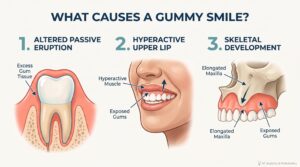
What Causes a Gummy Smile?
To fix a gummy smile, we first have to understand why it’s happening. There are three primary culprits:
- Altered Passive Eruption (Too Much Gum Tissue): Sometimes, the gums simply don’t recede normally as adult teeth come in. The teeth are a normal length, but they remain partially hidden under excess gum tissue, making them appear short or “boxy.”
- Hyperactive Upper Lip: The muscle that controls the upper lip is too strong. When you smile, the muscle pulls the lip up significantly higher than normal, exposing a large band of gum tissue.
- Skeletal Development: The upper jawbone (maxilla) grew downward further than average, resulting in an elongated upper face and more visible gum tissue.
Once we identify the underlying cause, we can choose the precise periodontal procedure to correct it.
The Solutions: How We Fix a Gummy Smile
There is no one-size-fits-all solution for excessive gingival display. At NC Implants and Periodontics, we specialize in highly effective, minimally invasive procedures to restore balance to your smile:
1. Esthetic Crown Lengthening (Gum Contouring)
- Best for: Patients whose teeth appear too short because they are covered by excess gum tissue.
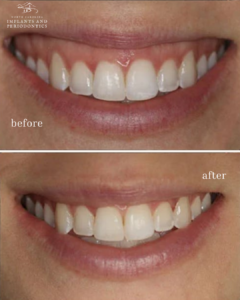
- How it works: Esthetic crown lengthening is essentially a gum lift. Using precise, minimally invasive techniques, we gently sculpt and remove the excess gum tissue (and sometimes a very small amount of underlying bone) to expose the full, natural length of your teeth.
- The result: Immediate transformation. Your teeth look longer, more proportional, and your gumline is perfectly symmetrical. The procedure is typically performed in a single visit under local anesthesia, and the results are permanent.
2. Lip Repositioning
- Best for: Patients who have a hyperactive upper lip that pulls up too high when they smile.
- How it works: Many patients use Botox to temporarily freeze the upper lip muscle, but Botox requires continuous, expensive maintenance every few months. Lip repositioning is a definitive, surgical alternative. We make a small adjustment to the tissue on the inside of your upper lip, restricting how high the lip can travel when you smile.
- The result: A beautiful, relaxed smile with balanced gum exposure. Because the entire procedure is performed inside the mouth, there is zero external scarring. Patients heal quickly, and often enjoy the added bonus of their upper lip appearing slightly fuller.
3. A Team Approach for Skeletal Causes
- Best for: Patients whose gummy smile comes from how the upper jaw developed, not from excess gum tissue or an overactive lip.
- When the upper jaw has grown longer than average, gum or lip procedures alone can’t fully correct the smile. In these cases, Dr. Morelli works alongside trusted orthodontists and oral and maxillofacial surgeons across the Triangle. Treatment may involve orthodontics to reposition the teeth, corrective jaw surgery in more significant cases, or a combination with crown lengthening or lip repositioning to fine-tune the result. Many patients have more than one contributing cause, which is why a thorough evaluation comes first.
- Are you a dentist or orthodontist with a patient who’s concerned about a gummy smile? Refer your patient here, and we’ll keep you updated throughout their care!
Comparing Your Options:
| Treatment | Best For | Procedure | Recovery | Longevity |
|---|---|---|---|---|
| Esthetic Crown Lengthening | Teeth that appear short or “boxy” due to excess gum covering the enamel | Gentle removal of excess gum and bone tissue to expose natural tooth length | 3–5 days mild tenderness | Permanent |
| Lip Repositioning | A hyperactive upper lip that lifts too high, exposing normal-sized teeth | In-office adjustment to the inside of the upper lip to limit upward retraction | 5–7 days mild tightness | Permanent (unlike Botox) |
Why Choose a Periodontist for Cosmetic Gum Procedures?
While some general dentists offer basic gum contouring, the architecture of the gums is complex. It requires an intimate understanding of the “biological width”—the natural spacing required between your bone, gums, and teeth to ensure the tissue remains healthy and doesn’t grow back over time.
As a periodontist, this is my specialty. We blend microsurgical precision with an artistic eye to ensure that your new gumline isn’t just beautiful on day one, but remains stable and healthy for the rest of your life.
Frequently Asked Questions About Gummy Smile Correction
Is gummy smile correction painful?
Both esthetic crown lengthening and lip repositioning are performed in-office using local anesthesia, ensuring you feel no pain during the procedure. Post-operative discomfort is typically mild and managed with over-the-counter pain relievers or a mild prescription. Most patients return to work within 24 to 48 hours.
Can a gummy smile come back after treatment?
When performed by a board-certified periodontist, these procedures provide permanent results. Unlike temporary treatments such as Botox—which require repeat injections every 3 to 4 months—surgical gum contouring and lip repositioning permanently alter the tissue architecture and do not require ongoing maintenance.
How much gum display is considered a “gummy smile”?
In esthetic dentistry, an ideal smile generally reveals 1 to 2 millimeters of gum tissue above the top teeth. When gum exposure exceeds 3 to 4 millimeters, it is clinically classified as excessive gingival display.
Does dental insurance cover gummy smile correction?
When performed purely for esthetic reasons, gummy smile treatments are generally considered cosmetic and are not covered by standard dental insurance. However, functional crown lengthening (needed to access tooth decay or place a crown) often receives partial insurance coverage.
Ready to Love Your Smile?
You shouldn’t have to hold back your joy. If a gummy smile is affecting your confidence, you owe it to yourself to explore your options.
Contact NC Implants and Periodontics in Raleigh today to schedule a cosmetic consultation. We will evaluate your smile, discuss your goals, and design a customized treatment plan to give you the balanced, harmonious smile you deserve.